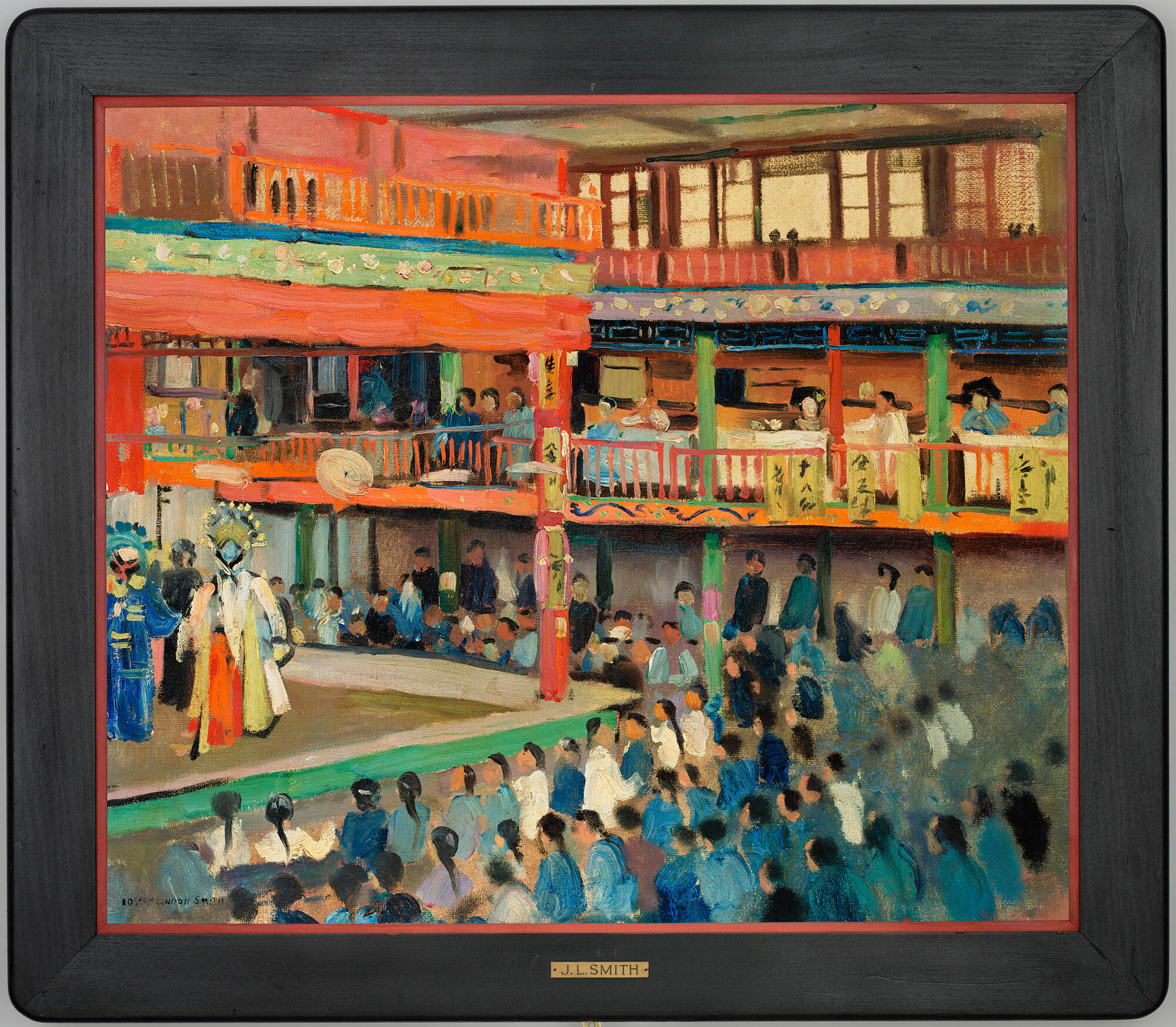
The view of Chinese theatre through the lens of the early 20th-century American art
Joseph Lindon Smith (1863-1950) was a distinguished American artist who achieved acclaim for his meticulous and vivid depictions of ancient artwork, particularly the Egyptian tomb reliefs. In addition to his artistic achievements, Smith was also a founding member of the art colony in Dublin, New Hampshire.
Smith’s passion for art prompted him to pursue studies at the prestigious School of the Museum of Fine Arts in Boston. In 1883, he embarked on a journey to Paris with his colleague and friend, Frank Weston Benson, to attend the esteemed Académie Julian. During his stay in Paris, he received instruction from eminent artists such as William Adolphe Bouguereau, Jules Joseph Lefebvre, and Gustave Boulanger.
In 1906, Smith embarked on a six-month voyage to Asia with the art collector and design theorist Denman Waldo Ross. They attended a Chinese opera performance during their sojourn in Mukden (now known as Shenyang). Smith painted “A Theater in Mukden, Manchuria” (circa 1910) to memorialize the event and incorporate aspects of the production into his own performances.
The painting offers a balcony box perspective of the vibrant interior architecture and the attentive audience. Smith used minimal brushstrokes to capture the intricate costumes and headdresses of the three actors on the stage, who likely narrated a story from a historical novel about a political or military conflict. The performance was accompanied by traditional Chinese string and percussion instruments, resulting in a multisensory experience.
Smith traveled extensively to Greece and Italy, often in the companionship of Benson, who painted a memorable portrait of him in 1884. During one of these excursions, Smith met Isabella Stewart Gardner, an art collector and philanthropist who later became a lifelong friend and patron. Both shared a fascination with Asian culture and antiquities, particularly Chinese culture. Gardner herself traveled to China in 1883-1884 and was captivated by Chinese ornaments and decorative arts.
In her later years, Gardner developed an avid interest in Chinese art and Chinese Buddhist art. While traveling to Beijing and Shanghai, she acquired textiles, snuff bottles, silk, fans, and opium boxes and creatively integrated them into her home. She created a new type of space called the Chinese Room in 1914, where she placed giant gilt bronze Buddhas, altar tables, and sumptuous silks. Although the room was not “authentic” to any particular area in Asia, the objects created a distinct ambiance.
In 1915, Isabella Stewart Gardner acquired the artwork titled “A Theater in Mukden, Manchuria” from Smith. This artwork is currently housed at the Isabella Stewart Gardner Museum in Boston, serving as a symbol of the artist’s and commissioner’s abiding passion for Asian and Chinese culture..