Klimt’s painting, influenced by Chinese art, was sold for the record-breaking £85.3m
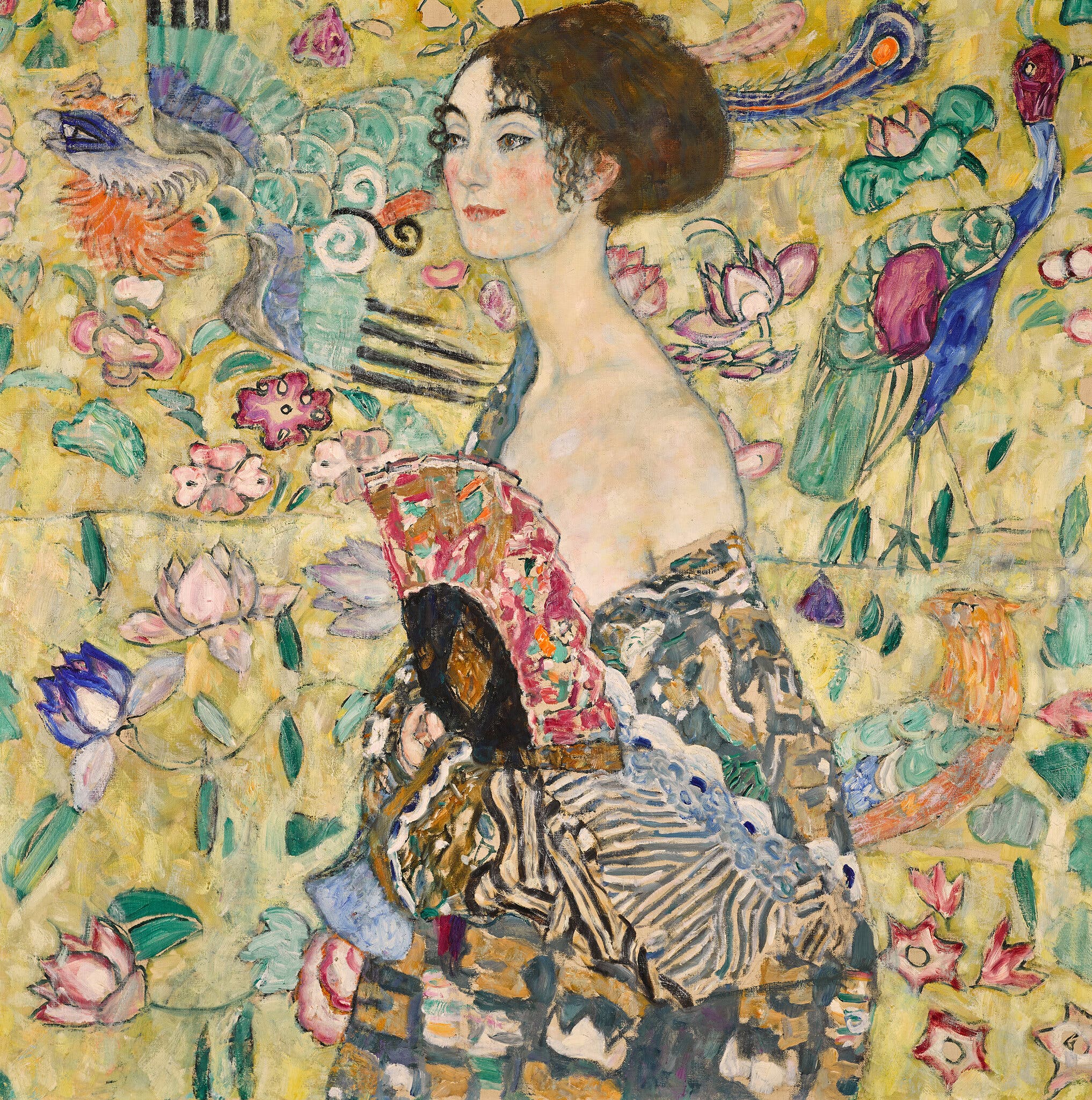
Gustav Klimt’s painting Dame mit Fächer (Lady with a Fan) has sold for a record-breaking £85.3m at Sotheby’s, becoming the most valuable work of art ever sold at auction in Europe.
The richly decorated background is an essential element of the later works and, in nearly all cases, reveals the artist’s growing interest in Japanese and Chinese art and culture. Although nothing remains of Klimt’s personal collection of these objects, evidence of its existence abounds. Writing just after Klimt’s death, Egon Schiele described the artist’s home: ‘…the sitting room, [was] furnished with a square table in the middle and a large number of Japanese prints covering the walls…and from there into another room whose wall was entirely covered by a huge wardrobe, which held his marvelous collection of Chinese and Japanese robes’ (quoted in Serge Sabarksy, Gustav Klimt: Drawings, London, 1983, p. 15). These fabrics and robes were augmented by Emilie Flöge’s own collection and reflected a prevailing trend among artists and collectors across Europe at the turn of the century.
Klimt himself owned an extraordinary collection of East Asian robes, which was destroyed by a bomb attack in 1945.
A photograph by Moritz Nähr of the reception room in Klimt’s workshop bears witness to Klimt’s passion for East Asian art. It shows parts of his collection of East Asian objets d’art, only a few of which remain to this day. A Chinese painting can be seen on the wall, and 10 Japanese-colored woodcuts are now missing, only 2 of which it has been possible to identify to date.
In Dame mit Fächer, Klimt draws principally on Chinese motifs, although it seems likely that his flattening of backgrounds and juxtaposition of patterns was encouraged by an interest in Japanese woodblock prints. Weidinger notes that the particular combination of imagery in this work is hard to interpret. Each element has a significance in Eastern culture: ‘The phoenix is a symbol of immortality and rebirth. In China, the creature stands for good fortune and fidelity, just as the heron or crane stands for happiness or contentment in old age. According to Chinese tradition, the lotus blossoms are interpreted as symbols of love and happy marriage; in Buddhism, they stand for the teachings of the Buddha and are, in general, a symbol of purity (A. Weidinger, op. cit., p. 304).
Klimt adopts both the motif itself as a template, as well as the typical color combinations used in Chinese objets d’art. The yellow background in Lady with Fan is similar to the imperial yellow found in Chinese objets d’art. Klimt imitated the typical enamel colors used in Chinese porcelain paintings, such as chrome yellow, cobalt blue, red ocher, copper green, and pink.
Klimt’s late work after 1910 also engages intensively with Chinese art. The decorative motifs Klimt uses in the backgrounds of his paintings, especially symbols of luck such as the phoenix (Feng-hua), crane, and lotus flower, as well as illustrations of buildings, warriors, plants, and clouds, are all inspired by Chinese porcelain paintings, robes, and other objects.