The Chinese porcelain- an integral part of the GILDED AGE American artistic vision
by Ani Margaryan
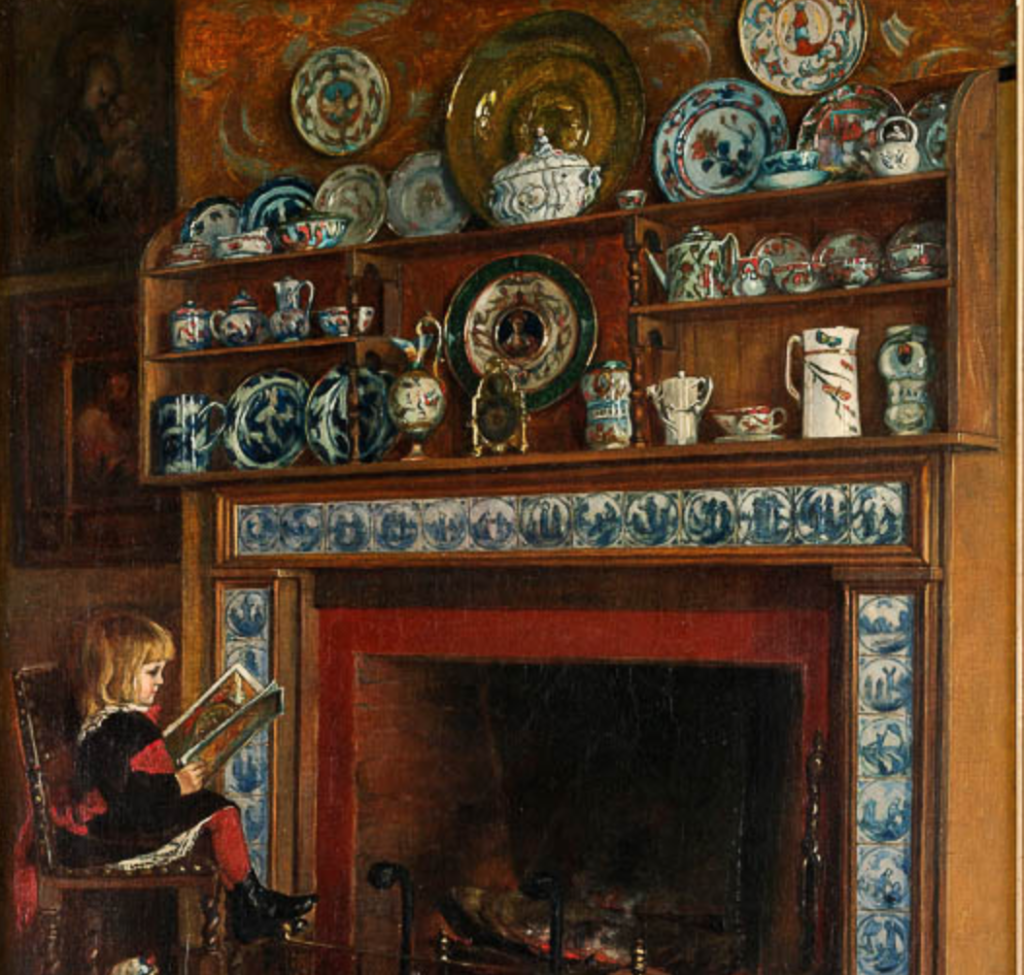
The Preservation Society of Newport County posted an artwork on its website that is of great interest within the context of Sino-American cultural interactions. An oil-on-canvas painting entitled “The Chimney Corner” (1878) by David Maitland Armstrong (American, 1836-1918) depicts a young Edward Maitland Armstrong seated at the tiled chimney-corner of the family’s Danskammer estate outside Newburgh, New York.
The viewer’s eyes are drawn to the sumptuous fireplace wall abundantly decorated with the carefully arranged Chinese, supposedly also Japanese and European-made blue-and-white ceramics.
The canvas showcases not only the exquisite taste of the artist and his interest in Chinese export porcelain but also the considerable impact of Chinese applied arts in the formation of the Gilded Age aesthetics in America. The concept of the employment of Chinese porcelain in the interior design of the upper class’s residences and artists’ studios might also be inspired by the flourishing Aesthetic movement (1860-1900) derived from the United Kingdom.
David Maitland Armstrong (1836– 1918) was Charge d’Affaires to the Papal States (1869), American Consul in Rome (1869–71), and Consul General in Rome (1871–73). He was also an important stained-glass artist and a painter. Armstrong was appointed Director of American Fine Arts at the 1878 Paris Exposition Universelle.